




What Is Statistical Process Control?
Statistical Process Control (SPC) is a way of controlling production or processes with the help of certain statistical techniques. With the right statistical control process, you’ll be able to effectively monitor all process activity, proactively identify and address any internal issues, and determine the best methods for fixing them at any point during production.
G.E. Mathis Company implements rigorous SPC tools and procedures to optimize our products and services. We serve companies across a variety of industries, with capabilities like precision laser cutting, welding, and other custom OEM solutions.

Statistical Process Control
In most cases, statistical process control relies on certain types of control charts, such as the IX-MR and X bar R charts. These charts are prepared in advance for machine operators, who would take measurements of a product characteristic and make measurement entries on the control chart. Using simple math, they plot points and draw lines from one point to the next. In the process, operators would be able to notice any potential issues based on the patterns present, including trends, freaks, and shifts in data.
Once they recognize these patterns, operators can then take the necessary steps to correct any out-of-control conditions present. As a result, processes benefit from improved performance, leading to high-quality output and reduced waste and rejections. The SPC procedure translates to customer satisfaction.
Statistical Process Control Tools
The following statistical tools are the most common ones used in business today:
- Pareto Charts
- Trend Charts
- Statistical Process Control (SPC)
- Histograms
- Cause-and-Effect Diagrams
- Structure Trees
- Scatter Plots/Diagrams
- Pie Charts
- Spider Charts
- Flow Charts
- Gantt Charts
- Stacked Area or Bar Charts
Statistical Process Control Benefits
SPC offers numerous advantages that make these solutions worth implementing.
Reduced Defects, Waste, and Rework
One of the main benefits of SPC is the development of streamlined processes that make it easier for operators to identify issues and correct them before they can develop into bigger problems. The end result is significantly reduced waste, a lower risk of defects, and the eliminated need for reworks.
Enhanced Product Quality
Another benefit of statistical process control is better product quality, as the SPC tools you use can help spot any problems during production. You can then begin correcting these issues, creating a continuous process that optimizes product quality while preventing shutdowns and downtime.
Elimination of Process Variation
The software and charts you use for the statistical control process will help you determine if there are any process variations to address. You’ll have access to comprehensible data in a graphical format that makes it easy to identify irregular patterns, enabling you to correct them and improve the process.
Compliance With Customer and Regulatory Requirements
SPC software also facilitates compliance with both industry regulations and customer requirements. Businesses can then maintain their operations without concerns over regulatory violations while providing customers with high-quality products that keep them happy.
Reduced, Controlled Expenses
Statistical process control tools help identify and mitigate imperfections in products and processes, helping to minimize the costs associated with rework.
Why Choose G.E. Mathis Company
As a contract manufacturer and job shop that implements SPC procedures, G.E. Mathis Company is committed to delivering high product quality and complete customer satisfaction. With our ISO 9001:2015 certification, we have a fully qualified management system that gives customers much-needed peace of mind. This certification, paired with our SPC tools, ensures we always produce the components you need at the quality and timeline your project requires.
Contact us today to begin your next project with us.
What Is the Production Part Approval Process (PPAP)?
G.E. Mathis Company is in the business of precision. We fabricate and supply high-quality parts, perform machining and contract manufacturing services, and help our clients create innovative solutions. Since our company’s start in 1905, we’ve been a leading provider of more than just manufacturing and fabricating services—we’re also committed to quality control, excellent customer service, and ensuring each part we supply is built to last.
Establishing robust quality control processes is essential to our mission, and Production Part Approval Processes (PPAPs) are a critical aspect of this. A PPAP is a standardized way to communicate about designs and production techniques throughout a manufacturing project in the aerospace or automotive industry. Learn more about the role of PPAPs in the industry, their benefits, and how to get the most value from them during your next manufacturing project.
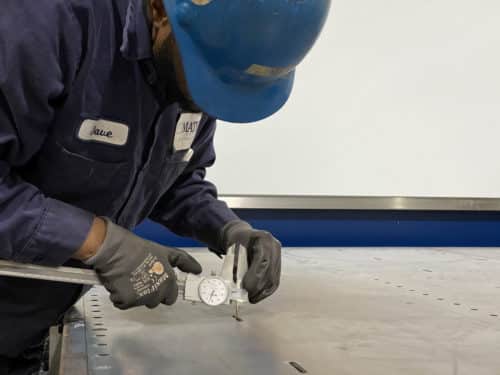
When Are PPAPs Required?
PPAPs are the final step in a broader Advanced Product Quality Planning (APQP) process. Its core purpose is to ensure parts manufacturers can scale up production to fulfill an order while still maintaining consistency, quality, and adherence to design requirements. PPAPs come in different levels of stringency, and customers can request their own requirements for a successful PPAP. For example, PPAP documents may include a detailed part dimensional inspection report so parts can be mapped to a layout, or they can just set general expectations.
Some of the key information a PPAP document provides includes:
- Details about part approval processes to ensure standard practices are followed
- Processes for approving part changes or method changes
- Required information that will be shared regarding part conformance and related data
- Record of conformance, including measurement of drift
- Design records that can be used to trace part design status throughout the project
While it occurs near the end of the planning process, customers can request a PPAP—and specify the details—early on in the business arrangement, such as in the provided Supplier Quality Assurance Manual (SQAM) or in a purchase order. In terms of the total manufacturing project, PPAPs are required when:
- A change is made to a planned production process
- Parts undergo a change
- A customer requests one (at any time during the product’s lifespan)
PPAP Benefits
Having a production part approval process that is standardized and fully understood by all parties can ensure a project goes smoothly and everyone has appropriate expectations for every stage of the manufacturing process. Key benefits include the following:
- Consistency: Stakeholders can use a standardized part approval process that is well-documented and offers consistency throughout the project.
- Conformity: Customers can be certain that approved parts meet their defined requirements.
- Documentation: Customers have evidence that the process is stable, remains consistent, and will follow established norms throughout production.
- Controlled Approval Process for Changes: Stakeholders can retain control of the process, even if it undergoes changes. PPAPs establish controlled approval mechanisms and channels so no changes threaten nonconformity as the project continues through later production stages.
Levels of a PPAP Submission
PPAPs can be customized to meet unique customer requirements, or they can operate within one of the five standard levels of PPAP submissions. These five levels are:
Level 1
This is a basic level. Submissions include a Part Submission Warranty (PSW) and no other documentation.
Level 2
This level requires a PSW, as well as product samples and some degree of agreed-upon supporting data.
Level 3
At this level, documentation includes a PSW, product samples, and comprehensive supporting data.
Level 4
This level offers more customized requirements. Along with a PSW, customers can set their own requirements for additional data and samples.
Level 5
This is the highest level. Documentation includes a PSW, product samples, and comprehensive supporting data. The information will remain available for stakeholders to review at the manufacturing site.
Manage Higher Quality Processes With G.E. Mathis Company
Quality control is our top priority at G.E. Mathis Company. Our company is ISO 9001:2015 certified, and we provide the following services to maintain a high level of product quality:
- Capability Studies (Statistical Process Control)
- Conflict Minerals Reporting Template (CMRT)
- First Article Inspection Report (FAIR)
- Production Part Approval Process (PPAP) (all levels available)
Our clients trust our dedication to high-quality manufacturing services and quality control management. Reach out today to learn more about quality assurance processes, metalworking capabilities, and more before starting your next order with us, or request a quote for pricing details.
First Article Inspection Reports 101 – What is FAI / FAIR
Mass production of products within the aerospace and defense industries requires an initial inspection known as the First Article Inspection (FAI) and a report on the results. G.E. Mathis Company is committed to providing the highest quality inspections and reports that comply with the AS9102 standards to ensure that products meet the correct specifications during manufacturing.
What is First Article Inspection?

At the beginning of a production run, all business quality systems provide a report of the inspection of one to five products straight off the manufacturing line. Regardless of whether the system is certified to ISO 9001, TS16949, or AS9102 standards, quality inspection for compliance with the documentation or customer requirements must be completed before the production run continues. Included in the review are the measurements of the layout to ensure conformity.
Other testing may include material tests and reports, appearance approvals, and more. Once all documents are received, the First Article Inspection Report (FAIR) provides the customer with a review of the product and sets the expectation for the outcome of the full production run. Customers indicate how many parts, between one and five, require inspection in the FAI before approval to continue the run.
First Article Inspection Reports (FAIR)
A First Article Inspection Report (FAIR) can be requested during a mass production run to ensure consistent product quality. However, the FAIR process typically begins by validating the manufacturing processes and the associated equipment, including when:
- Introducing New Parts
- Revising Existing Parts
- New Locations for Manufacturing
- New Supplier of Parts
- Resuming manufacturing after two years
Each FAIR has three forms that must meet the expectations outlined in the documentation. The forms include the part number accountability, product accountability, and characteristic accountability inspection forms. Two forms of inspection are carried out to ensure quality control and product reliability. The first form is dedicated to identifying the part that requires review, along with any sub-assemblies that may affect the quality of the final product. This form helps to ensure that quality issues are identified and resolved at the earliest stages of production.
The second form, product accountability, is a more comprehensive inspection process that covers all related materials, methods, and functional tests demanded by the product design. This form is crucial in ensuring that all product components function correctly and meet the required specifications. By conducting this inspection, any potential defects or issues that may arise during the product’s use can be identified and addressed, resulting in a more reliable and long-lasting product.
Finally, the characteristic accountability inspection ensures that the characteristics, dimensions, tolerances, and aesthetics align with the customer’s specifications. This form includes a detailed drawing or model pinpointing the necessary features identifiable by ballooned or bubbled numbers. A key provides details on the numbered aspects of the picture. The tools used to produce the product are included in the inspection for quality at this time.
Choosing G.E. Mathis Company for Your FAIR
Parts manufacturing is becoming more complex as the parts themselves evolve. Ensuring that each piece manufactured complies with all specified restrictions and requirements is essential to ensure products are successful after assembly. Completing a FAIR inspection during the manufacturing process ensures compliance with regulations and provides clients with product details.
Quality, integrity, and craftsmanship are at the forefront of our values at G.E. Mathis Company. Our dedication to our customers’ success is unwavering, and we strive to uphold these principles in everything we do. In addition to being an ISO 9001:2015-certified manufacturer, G.E. Mathis Company can provide the following services:
- FAIR (First Article Inspection Report)
- PPAP (Production Part Approval Process) – All Levels
- Capability Studies (Statistical Process Control)
- CMRT (Conflict Minerals Reporting Template)
Don’t hesitate to contact us today to learn more about G.E. Mathis Company and how we can apply our metal fabrication capabilities to your next project. Request a quote for your project or FAI assignment and get the expert help your facility deserves.